
Date: Sep 06, 2026, Version: 0.7.12

PackLab#
PackLab computes structure in three-dimensional hard-sphere systems. Its primary analytical workflow evaluates the Percus–Yevick (PY) approximation for equilibrium mixtures. It also generates explicit random sequential adsorption (RSA) configurations and samples fixed-volume equilibrium configurations with Metropolis Monte Carlo (MC).
Badge |
Status |
|---|---|
Python versions |
|
Documentation |
|
Continuous integration |
|
Test coverage |
|
PyPI package |
|
PyPI downloads |
|
Anaconda package |
|
Anaconda downloads |
|
Latest Anaconda release |
|
Citation |
|







The workflows share physical inputs such as particle radii, number fractions, and volume fraction, but they answer different questions:
PY is a fast analytical equilibrium reference for pair correlations, structure factors, and structure-aware scattering calculations.
RSA creates an explicit, non-overlapping deposition configuration. It is irreversible and retains the history of accepted particles.
Metropolis MC moves particles in a valid configuration to sample an equilibrium hard-sphere system at fixed volume, particle count, and radii.
Installation#
Install the core package from PyPI:
pip install packlab
For scattering calculations, install the optional PyMieSim integration:
pip install "packlab[scattering]"
Or install the Conda package:
conda install -c martinpdes packlab
Verify the compiled package with:
python -c "import PackLab; print(PackLab.__version__)"
1. Compute a Percus–Yevick equilibrium reference#
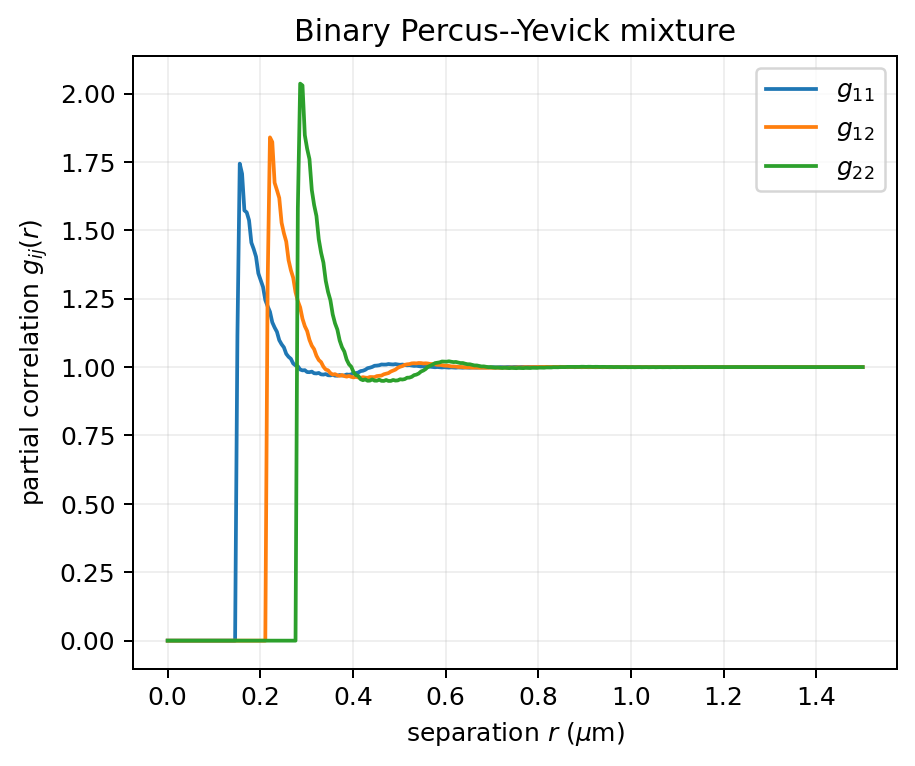
Use PY when you need equilibrium mixture correlations without generating an explicit packing. PackLab computes the partial pair correlations \(g_{ij}(r)\) and reciprocal-space correlations on an automatically resolved wavenumber grid.
import numpy as np

from PackLab import analytical, ureg

radii = np.array([75, 140]) * ureg.nanometer
domain = analytical.PercusYevickDomain(
    size=50 * ureg.micrometer,
    radii=radii,
    volume_fraction=0.25,
    number_fractions=np.array([0.7, 0.3]),
)
distances = np.linspace(0.0, 1.5, 300) * ureg.micrometer
result = analytical.PercusYevickSolver(
    densities=domain.particle_densities_per_radius,
    radii=domain.radii,
    wavenumber="auto",
).compute(distances)

g_12 = result.g[0, 1]
wavenumber = result.wavenumber
The automatic grid is a useful default. For a resolution study, use
analytical.make_wavenumber_grid(...) and compare the resulting curves.
PY is an analytical approximation to an equilibrium hard-sphere mixture; it
does not create particle centres or reproduce the irreversible RSA process.
2. Generate an explicit RSA packing#
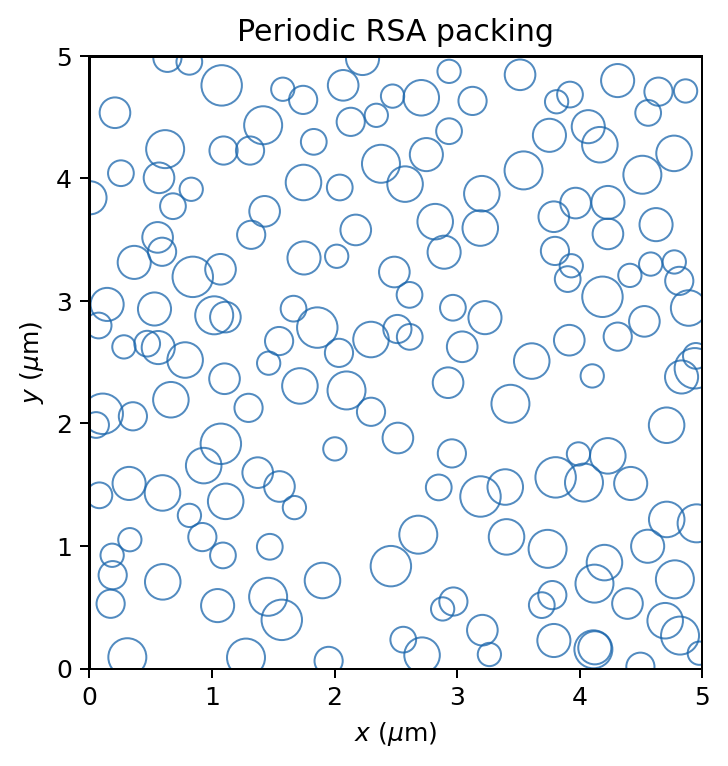
RSA proposes particles one at a time and keeps only non-overlapping proposals. Accepted particles never move, so the final configuration is physically valid but history-dependent rather than an equilibrium sample.
from PackLab import monte_carlo, samplers, ureg

domain = monte_carlo.PackingDomain(
    5 * ureg.micrometer,
    5 * ureg.micrometer,
    5 * ureg.micrometer,
    use_periodic_boundaries=True,
)
sampler = samplers.UniformRadiusSampler(
    90 * ureg.nanometer,
    170 * ureg.nanometer,
    bins=8,
)
options = monte_carlo.RSAOptions()
options.random_seed = 42
options.maximum_attempts = 40_000
options.target_packing_fraction = 0.12

rsa_result = monte_carlo.RSASimulator(domain, sampler, options).run()
print(rsa_result.statistics.packing_fraction_geometry)
figure = rsa_result.plot_slice_2d(show=False)
PackingResult provides accepted centres, sampled radii, packing
statistics, pair-correlation estimators, and plotting helpers. Radius samplers
support constant, uniform, normal, log-normal, and discrete distributions.
3. Equilibrate hard spheres with Metropolis MC#
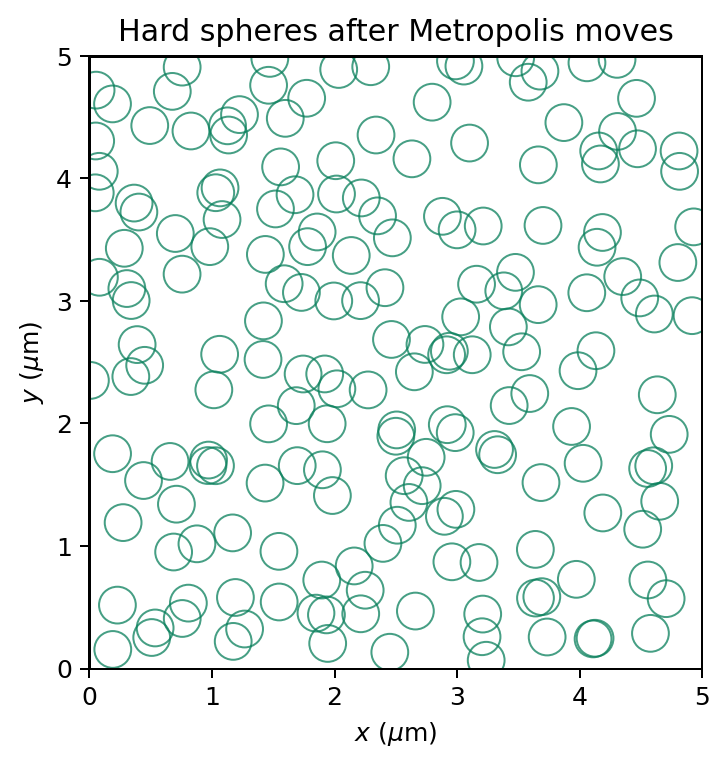
Use Metropolis MC when an equilibrium configuration is needed. It can start from the valid RSA configuration above, but then proposes particle displacements; particle count, radii, and class labels remain fixed.
options = monte_carlo.MetropolisOptions()
options.random_seed = 34
options.number_of_sweeps = 500
options.maximum_displacement = 50 * ureg.nanometer

simulator = monte_carlo.MetropolisSimulator(
    domain,
    rsa_result.sphere_configuration,
    options,
)
mc_result = simulator.run()
print(simulator.statistics.acceptance_rate)
figure = mc_result.plot_slice_2d(show=False)
The number of sweeps alone does not establish equilibration. Discard an initial burn-in interval, assess autocorrelation for the quantity of interest, and compare larger systems when finite-size effects may matter.
Choosing the right workflow#
Workflow |
Use it when you need |
Important limitation |
|---|---|---|
PY analytical |
Fast equilibrium pair correlations, structure factors, parameter sweeps, or scattering inputs. |
It is an equilibrium approximation, not an explicit packing. |
RSA |
Particle centres, radius-sampling effects, deposition history, or a finite non-overlapping configuration. |
It is irreversible and is not an equilibrium sampler. |
Metropolis MC |
An explicit equilibrium hard-sphere configuration at fixed volume and composition. |
Equilibration, autocorrelation, and finite-size effects require checks. |
Scattering#
The optional PackLab.scattering workflow computes optical amplitudes with
PyMieSim. Combine them with the PY correlation tensor when you need a
structure-corrected mixture phase function. See the
scattering examples
for runnable single-particle and mixture calculations.
Documentation, validation, and citation#
The online documentation contains theory, API reference, output conventions, assumptions, and executable galleries for PY, RSA, Metropolis MC, scattering, validation, and benchmarks.
For development:
git clone https://github.com/MartinPdeS/PackLab.git
cd PackLab
pip install -e ".[testing,documentation]"
pytest
If PackLab contributes to academic work, cite the archived Zenodo release you
used. Release metadata is included in .zenodo.json.