
Note
Go to the end to download the full example code.
RSA generation scaling#
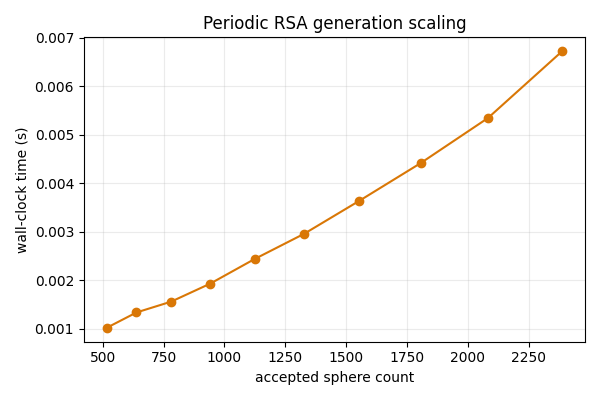
This benchmark measures the time to generate periodic random sequential adsorption (RSA) configurations as the box volume, and therefore the requested particle count, increases. The radius, target packing fraction, and stopping criteria remain fixed.
The timings are specific to the machine and build configuration. They describe RSA insertion cost, not equilibrium sampling or agreement with an analytical hard-sphere model.
from time import perf_counter

import matplotlib.pyplot as plt
import numpy as np

from PackLab import monte_carlo, samplers, ureg
Define a fixed RSA workload#
radius = 100 * ureg.nanometer
target_packing_fraction = 0.08
box_lengths = np.linspace(3.0, 5.0, 10) * ureg.micrometer
sampler = samplers.ConstantRadiusSampler(radius=radius)
Time configuration generation at increasing box sizes#
sphere_counts = []
elapsed_seconds = []

for index, box_length in enumerate(box_lengths):
    domain = monte_carlo.PackingDomain(
        box_length,
        box_length,
        box_length,
        use_periodic_boundaries=True,
    )
    options = monte_carlo.RSAOptions()
    options.random_seed = 2026 + index
    options.maximum_attempts = 50_000
    options.maximum_consecutive_rejections = 10_000
    options.target_packing_fraction = target_packing_fraction

    started = perf_counter()
    result = monte_carlo.RSASimulator(domain, sampler, options).run()
    elapsed_seconds.append(perf_counter() - started)
    sphere_counts.append(result.statistics.sphere_count)
    print(
        f"{box_length.to('micrometer').magnitude:.1f} µm box: "
        f"{sphere_counts[-1]:4d} spheres in {elapsed_seconds[-1]:.3f} s"
    )
3.0 µm box:  516 spheres in 0.001 s
3.2 µm box:  639 spheres in 0.001 s
3.4 µm box:  781 spheres in 0.002 s
3.7 µm box:  942 spheres in 0.002 s
3.9 µm box: 1124 spheres in 0.002 s
4.1 µm box: 1328 spheres in 0.003 s
4.3 µm box: 1555 spheres in 0.004 s
4.6 µm box: 1806 spheres in 0.004 s
4.8 µm box: 2083 spheres in 0.005 s
5.0 µm box: 2388 spheres in 0.007 s
Display generation time against the realised workload#
figure, axis = plt.subplots(figsize=(6, 4))
_ = axis.plot(sphere_counts, elapsed_seconds, "o-", color="#d97706")
_ = axis.set(
    xlabel="accepted sphere count",
    ylabel="wall-clock time (s)",
    title="Periodic RSA generation scaling",
)
axis.grid(alpha=0.25)
figure.tight_layout()
Total running time of the script: (0 minutes 0.124 seconds)