
Note
Go to the end to download the full example code.
Analytical evaluation scaling#
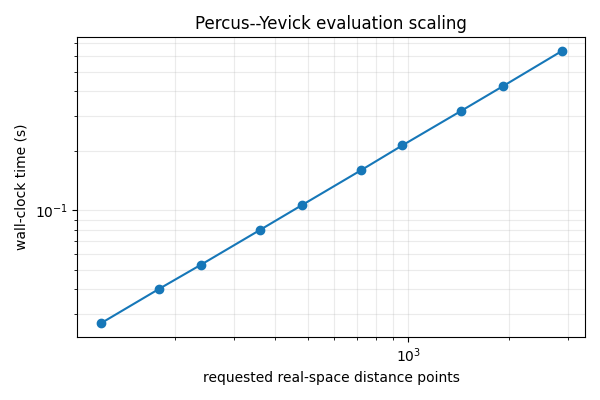
This benchmark measures the wall-clock time required to evaluate a fixed binary Percus–Yevick mixture at increasingly dense real-space distance grids. It measures computational cost only; it is not a numerical-convergence or physical-validation test.
Run it on the target machine and report the Python environment, processor, and the median of several repetitions when comparing results between systems.
from time import perf_counter

import matplotlib.pyplot as plt
import numpy as np

from PackLab import analytical, ureg
Define a fixed physical mixture#
radii = np.array([0.75, 1.5]) * ureg.micrometer
domain = analytical.PercusYevickDomain(
    size=100_000 * ureg.micrometer,
    radii=radii,
    volume_fraction=0.20,
    number_fractions=np.array([0.5, 0.5]),
)
solver = analytical.PercusYevickSolver(
    densities=domain.particle_densities_per_radius,
    radii=domain.radii,
    wavenumber="auto",
)
Time evaluations at different distance-grid sizes#
point_counts = np.array([120, 180, 240, 360, 480, 720, 960, 1440, 1920, 2880])
elapsed_seconds = []

for point_count in point_counts:
    distances = np.linspace(0.0, 12.0, point_count) * ureg.micrometer
    started = perf_counter()
    result = solver.compute(distances)
    elapsed_seconds.append(perf_counter() - started)
    print(
        f"{point_count:4d} distances: {elapsed_seconds[-1]:.3f} s "
        f"({len(result.wavenumber)} wavenumber points)"
    )
 120 distances: 0.027 s (1922 wavenumber points)
 180 distances: 0.040 s (1922 wavenumber points)
 240 distances: 0.053 s (1922 wavenumber points)
 360 distances: 0.080 s (1922 wavenumber points)
 480 distances: 0.106 s (1922 wavenumber points)
 720 distances: 0.159 s (1922 wavenumber points)
 960 distances: 0.213 s (1922 wavenumber points)
1440 distances: 0.318 s (1922 wavenumber points)
1920 distances: 0.423 s (1922 wavenumber points)
2880 distances: 0.636 s (1922 wavenumber points)
Display the workload and timing result#
figure, axis = plt.subplots(figsize=(6, 4))
_ = axis.loglog(point_counts, elapsed_seconds, "o-", color="#1677b8")
_ = axis.set(
    xlabel="requested real-space distance points",
    ylabel="wall-clock time (s)",
    title="Percus--Yevick evaluation scaling",
)
axis.grid(alpha=0.25, which="both")
figure.tight_layout()
Total running time of the script: (0 minutes 2.226 seconds)