Ctrl+K
MomentRT deterministic light transport MomentRT deterministic light transport
  • Start
  • Guide
  • Examples
  • Theory
  • Reference
  • GitHub
  • PyPI
  • Anaconda
  • Start
  • Guide
  • Examples
  • Theory
  • Reference
  • GitHub
  • PyPI
  • Anaconda

Section Navigation

  • Getting started
    • Infinite-medium diffusion
    • Simulate a contact sensor on layered skin
    • A heterogeneous layered sample
    • Surface illumination and FEM diffusion
  • Samples and meshes
    • Create a Cartesian mesh from physical resolution
    • Create a Cartesian mesh from node counts
    • Build samples with named models
    • Create a uniform tetrahedral mesh
    • Refine a tetrahedral mesh near layers and contacts
  • Sources and detectors
    • Choose a mesh for detector collection
    • Seven-fiber bundle on a three-layer skin sample
    • Collect light with finite apertures
    • Uniform illumination on a sample face
  • Spectral calculations
    • Integrate a source spectrum and detector response
    • Build analytical source spectra
    • Sweep wavelength-dependent scattering anisotropy
    • Sweep wavelengths with a fixed sensor geometry
  • Transport models
    • Compare full P3 with SP3 and P1
    • Compare P1 and SP3 transport
    • Compare scattering phase functions
    • Use different anisotropies in a layered sample
    • Follow a diffuse pulse through layered tissue
  • Parameter studies
    • How absorption changes fluence
    • Changing the diffuse boundary reflectance
    • How dermis thickness changes a two-fiber scan
    • Two-fiber reflectance and dermal absorption
    • Which skin layer changes the fiber signal?
    • Benchmark P1, SP3, and P3 solver scaling
  • Validation
    • Check finite-element mesh refinement
    • Compare P1 and SP3 with independent planar slab references
    • Compare sensor-validation cases
  • Inverse problems
    • Recover an epidermis change
    • Check detector mesh convergence
    • Explore a synthetic objective landscape
  • Examples
  • Getting started

Getting started#

Start with a skin contact sensor, an analytical calculation, or a finite sample, then explore structured geometry.


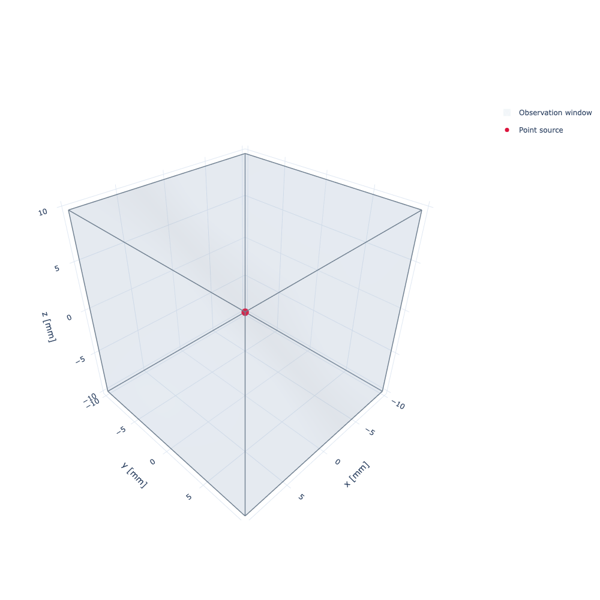
Infinite-medium diffusion

Infinite-medium diffusion

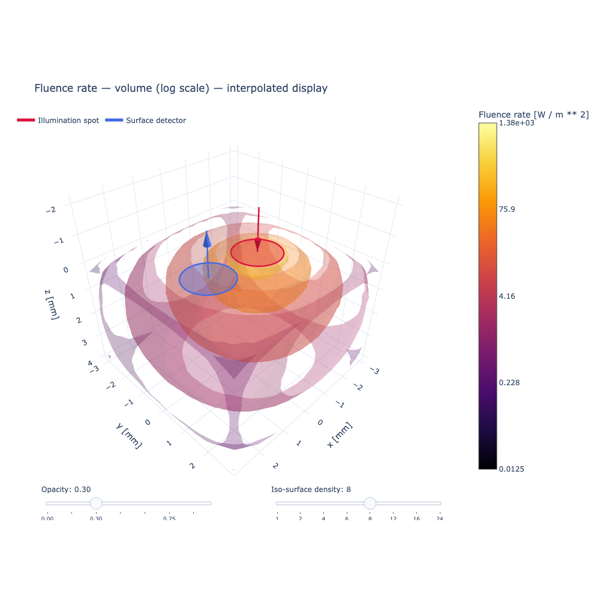
Simulate a contact sensor on layered skin

Simulate a contact sensor on layered skin

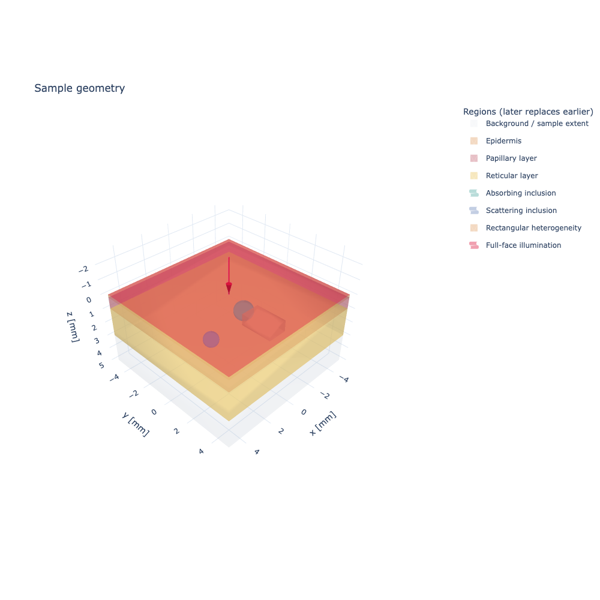
A heterogeneous layered sample

A heterogeneous layered sample

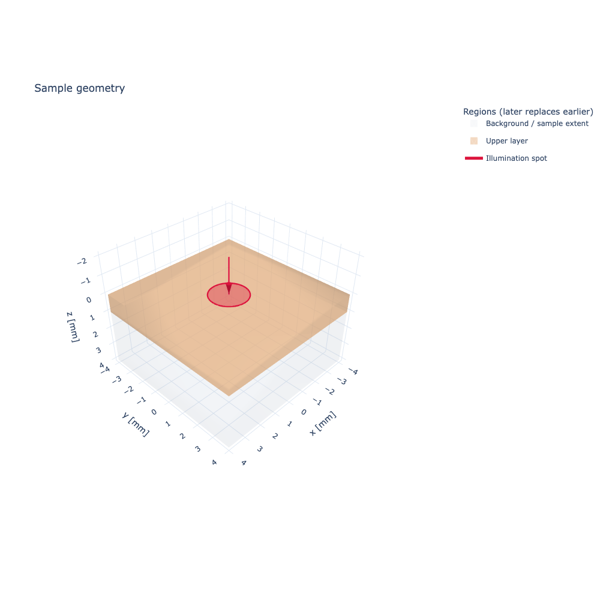
Surface illumination and FEM diffusion

Surface illumination and FEM diffusion

Gallery generated by Sphinx-Gallery

previous

Examples

next

Infinite-medium diffusion

Edit on GitHub
Show Source

© Copyright Martin Poinsinet de Sivry-Houle.