
Note
Go to the end to download the full example code.
InfiniteCylinder: Coupling vs Wavelength#
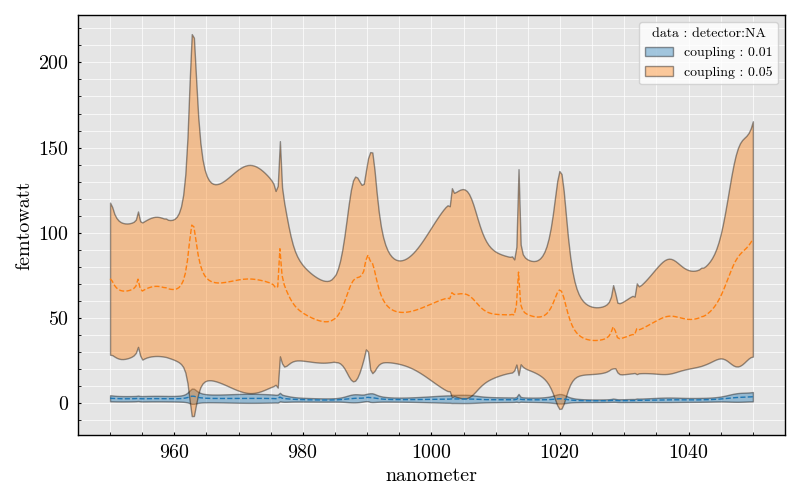
This example demonstrates how to compute and visualize the coupling efficiency as a function of wavelength for cylindrical scatterers using PyMieSim.
+-----------------------+-----------------------+
| Sellmeier Materials   | Tabulated Materials   |
+=======================+=======================+
| fused_silica          | calcium               |
+-----------------------+-----------------------+
| water                 | gold                  |
+-----------------------+-----------------------+
| BAK1                  | copper                |
+-----------------------+-----------------------+
| soda_lime_glass       | silicon               |
+-----------------------+-----------------------+
| lithium_niobate       | aluminium             |
+-----------------------+-----------------------+
| argon                 | iron                  |
+-----------------------+-----------------------+
| flint                 | polyetylene           |
+-----------------------+-----------------------+
| BAF10                 | sodium                |
+-----------------------+-----------------------+
| germanium             | silver                |
+-----------------------+-----------------------+
| air                   | nickel                |
+-----------------------+-----------------------+
| crown                 | zinc                  |
+-----------------------+-----------------------+
| SF5                   |                       |
+-----------------------+-----------------------+
| polystyren            |                       |
+-----------------------+-----------------------+
| BK7                   |                       |
+-----------------------+-----------------------+
| acetone               |                       |
+-----------------------+-----------------------+
| ZBLAN                 |                       |
+-----------------------+-----------------------+

[<matplotlib.lines.Line2D object at 0x7fd4f5820350>, <matplotlib.collections.FillBetweenPolyCollection object at 0x7fd4f5822c90>, <matplotlib.lines.Line2D object at 0x7fd4f5850250>, <matplotlib.collections.FillBetweenPolyCollection object at 0x7fd4f58507d0>]
import numpy as np
from PyMieSim import (
    ureg,
    CoherentModeSet,
    InfiniteCylinderSet,
    GaussianSet,
    PolarizationSet,
    Experiment,
    print_available,
    SellmeierMaterial,
)


print_available()

polarization_set = PolarizationSet(
    angles=[30.0] * ureg.degree,
)

source = GaussianSet(
    wavelength=np.linspace(950, 1050, 300) * ureg.nanometer,
    polarization=polarization_set,
    optical_power=[1e-3] * ureg.watt,
    numerical_aperture=[0.2],
)

scatterer = InfiniteCylinderSet(
    diameter=np.linspace(300, 500, 5) * ureg.nanometer,
    material=[SellmeierMaterial("BK7")],
    medium=[1],
)

detector = CoherentModeSet(
    mode_number=["LP11"],
    numerical_aperture=[0.05, 0.01],
    phi_offset=[-180] * ureg.degree,
    gamma_offset=[0] * ureg.degree,
    sampling=[300],
    rotation=[0] * ureg.degree,
)

experiment = Experiment(scatterer_set=scatterer, source_set=source, detector_set=detector)

result = experiment.get("coupling")

result.plot(x="source:wavelength", std="scatterer:diameter")
Total running time of the script: (0 minutes 0.711 seconds)