
Note
Go to the end to download the full example code.
Sphere: Qsca vs index#
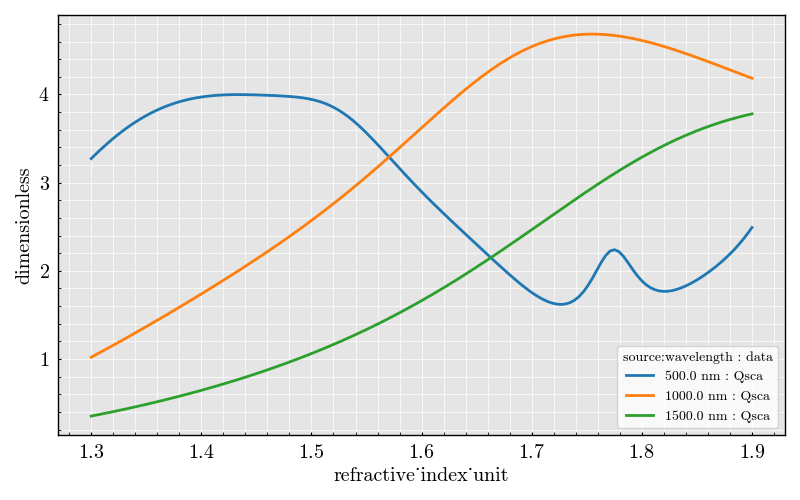
/opt/hostedtoolcache/Python/3.11.16/x64/lib/python3.11/site-packages/matplotlib/cbook.py:1719: ComplexWarning: Casting complex values to real discards the imaginary part
  return math.isfinite(val)
/opt/hostedtoolcache/Python/3.11.16/x64/lib/python3.11/site-packages/matplotlib/cbook.py:1355: ComplexWarning: Casting complex values to real discards the imaginary part
  return np.asarray(x, float)

[<matplotlib.lines.Line2D object at 0x7fd4f7c7cf50>, <matplotlib.lines.Line2D object at 0x7fd4f45be610>, <matplotlib.lines.Line2D object at 0x7fd4f45bd290>]
import numpy as np
from PyMieSim import (
    ureg,
    SphereSet,
    GaussianSet,
    PolarizationSet,
    Experiment,
)


polarization_set = PolarizationSet(
    angles=[30.0] * ureg.degree,
)

source = GaussianSet(
    wavelength=[500.0, 1000.0, 1500.0] * ureg.nanometer,
    polarization=polarization_set,
    optical_power=[1e-3] * ureg.watt,
    numerical_aperture=[0.2],
)

scatterer = SphereSet(
    diameter=[800.0] * ureg.nanometer,
    material=np.linspace(1.3, 1.9, 100),
    medium=[1.0],
)

experiment = Experiment(scatterer_set=scatterer, source_set=source)

result = experiment.get("Qsca")

result.plot(x="scatterer:material")
Total running time of the script: (0 minutes 0.216 seconds)